 Fitness Home Journal

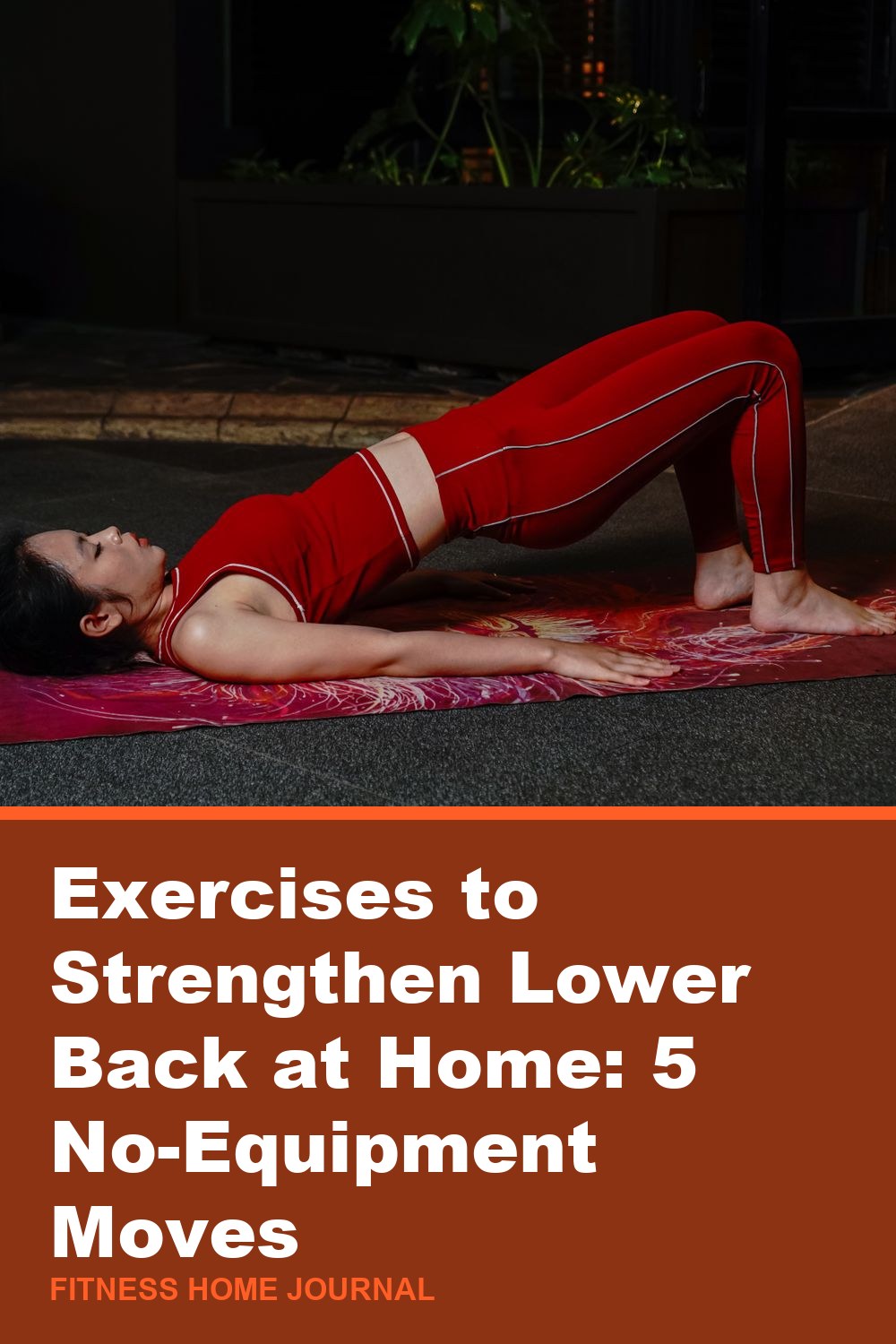

- Do two sets of eight slow reps per move (four per side), resting 60 seconds, then build to 12 reps (six per side).
- Glute bridge, bird dog, prone leg lift, Y to W raise and side-to-side extension need only a mat and about 20 minutes.
- Pain that radiates or is severe means seeing a doctor or physical therapist before you start, not testing the routine.
The best home routine for a stronger lower back is five slow, floor-based moves: glute bridge, bird dog, alternating prone leg lift, prone Y to W raise and side-to-side back extension. You need a mat and nothing else. Fit&Well published this routine, written by personal trainer Maddy Biddulph, and it suits anyone whose back gets stiff after a long day at a desk. If your pain radiates into a leg or is severe, see a doctor before you try any of it.
Check your back before you start
Biddulph is clear that back pain can have many causes. Strengthening the muscles that support your spine is a good way to look after it, she says, alongside staying active and taking regular movement breaks. She also advises speaking to a physical therapist first if you have back issues, an injury or any concern.
My version of that rule: if pain shoots or travels into a buttock or leg, or if it is severe, get it assessed before you train. Fit&Well contributing editor Yanar Alkayat spent two years rehabbing a bulging disc with sciatic nerve pain. She notes that most experts agree stopping all movement is the worst response, but that does not mean you should work this out alone. A professional can tell you which movements are right for your back.
Neither article cites trial data showing how much a routine like this reduces pain, so treat it as sensible strength work, not a treatment.
How to run the routine: sets, reps and rest
Do two sets of each exercise before moving to the next. Start with eight slow, controlled reps per set, or four per side for one-sided moves. Rest 60 seconds between sets. As you get stronger, build to 12 reps per set, or six per side. Stay inside a comfortable range of motion every time.
The whole circuit takes roughly 20 minutes at a calm pace, rests included. That is my estimate, not a figure from Fit&Well. A phone timer helps you keep the 60-second rests honest. If you want a warm-up first, our mobility moves before a workout are a good place to start.
The five moves, step by step
1. Glute bridge (2 sets of 8)
- Lie on the mat with knees bent and feet flat, hip-width apart and close to your glutes.
- Rest your arms by your sides and relax your shoulders.
- Press through your feet and lift your hips until shoulders, hips and knees form one straight line.
- Pause briefly, lower, and repeat without arching your lower back.
This works mainly the gluteus maximus, with help from the hamstrings, while your back and abs keep the spine and pelvis steady.
2. Bird dog (2 sets of 4 per side)
- Start on hands and knees, knees hip-width apart, shoulders over wrists.
- Reach your right arm forward and your left leg back, keeping your hips level.
- Pause, then switch sides.
If you wobble, start by extending only the arm and add the leg once you feel steadier. This move trains the erector spinae and the multifidus, the small muscles that stabilize the vertebrae.
3. Alternating prone leg lift (2 sets of 4 per side)
- Lie face down with your forehead resting on your hands.
- Lift your right leg a few centimeters, knee straight, both hips staying on the mat.
- Lower slowly, then switch legs.
Keep the lift small. It is mostly a hip-strengthening move, with your lower-back muscles holding the pelvis still.
4. Prone Y to W raise (2 sets of 8)
- Lie face down, forehead on the mat, arms reaching out in a Y.
- Lift your arms a few centimeters off the mat.
- Bend your elbows and draw them toward your ribs into a W, gently squeezing your shoulder blades together.
- Keep your neck relaxed and shoulders away from your ears.
- With arms still lifted, reach back to the Y, then lower. That is one rep.
This is the upper-back piece: it challenges the lower and middle trapezius, rhomboids and rotator cuff muscles.
5. Side-to-side back extension (2 sets of 4 per side)
- Lie face down with fingertips lightly at the sides of your head.
- Lift your chest slightly, gaze down, neck in line with your spine.
- Keeping your hips on the mat, bend sideways and bring your right elbow toward your right hip.
- Return to center, then go to the left. Each side bend is one rep.
Holding the chest up works the spinal extensors. The side bend adds the quadratus lumborum in your lower back and the obliques.
Common mistakes that waste the work
- Arching the lower back. In the bridge and the Y to W raise, the cue is to avoid arching. If your back does the lifting, the move has gone wrong.
- Lifting too high. In prone leg lifts, a few centimeters is the target. Higher usually means twisting the hips.
- Rushing. Slow, controlled reps are the point. Speed lets momentum do the work.
- Letting the hips drift. In the bird dog, keep the pelvis level. In the side extension, keep the hips on the mat.
- Shrugging. Keep shoulders away from your ears in the Y to W raise.
- Chasing range. Work inside a comfortable range. A smaller, cleaner movement beats a bigger, sloppy one.
A simple checkpoint: are you ready to add reps?
Before you move from eight reps to 12 (four to six per side), check four things in one session:
- You can hold the bridge line from shoulders to knees without your lower back arching.
- You can finish the bird dog on both sides without your hips tipping.
- Every rep feels slow and controlled in the last set, not just the first.
- You feel muscle work, not sharp pain, and nothing travels down a leg.
Pass all four and add a rep or two per set the next time. Miss one and stay at your current number. If the fourth point fails, stop and talk to a doctor or physical therapist. Biddulph also suggests having a personal trainer check your form, and filming a set or two from the side is a cheap substitute.
A gentler option on stiff or sore days
Alkayat relied on three gentle yoga poses while recovering, and she stresses staying within whatever range feels comfortable, even if that is only a few inches. She suggests listening closely to your body and dropping any idea of reaching a perfect shape. Her three are:
- Sphinx pose: 3-5 slow reps, lifting chest and head on an inhale and lowering on an exhale, pain-free only.
- Flapping fish pose: 5-6 breaths each side, lying on your front with one knee bent out to the side.
- Reclining pigeon pose: 3-5 reps each side, on your back with one ankle crossed over the opposite knee.
These are mobility work, not a replacement for the strength routine, and they are best done with guidance if you are managing an injury.
Where to go next
Once the five moves feel easy at 12 reps, fold them into a wider plan. Our no-equipment home strength routine covers the rest of the body. If you later want to lift heavier, learn the hinge properly with our guide to the barbell deadlift with proper form, ideally after your back has handled these basics without complaint.
FAQ
Do I need any equipment for these lower back exercises?
Only a mat. Every move uses your body weight, which is why Biddulph likes this routine for training between sessions with a coach.
How slowly should I move?
Slowly enough that each rep is controlled. Fit&Well's cue is slow, controlled reps within a comfortable range of motion, with a pause at the top of the bridge and bird dog.
As an Amazon Associate I earn from qualifying purchases: if you buy through these links I may earn a small commission, at no extra cost to you. Each link opens a search on the Amazon store for your country.
Watch or listen to this episode
Sources
- Fit&Well: Five beginner-friendly moves you can do without equipment to strengthen your back
- Fit&Well: Three gentle yoga poses for your lower back when it needs extra care
Photo: Firman Marek_Brew / Pexels

I'm an Italian creator who builds apps, games and websites. I run Fitness Home Journal with the help of AI tools: every article starts from the sources linked above, and I check what goes out. I'm not a doctor, a lawyer or a financial adviser. Spotted a mistake or have an idea? Write to me.
Instagram @spartaco_94_My websiteWrite to meAbout this blog










 Reinventing Yourself After 40: A Guide to Embracing Change and New Beginnings





