 Fitness Home Journal

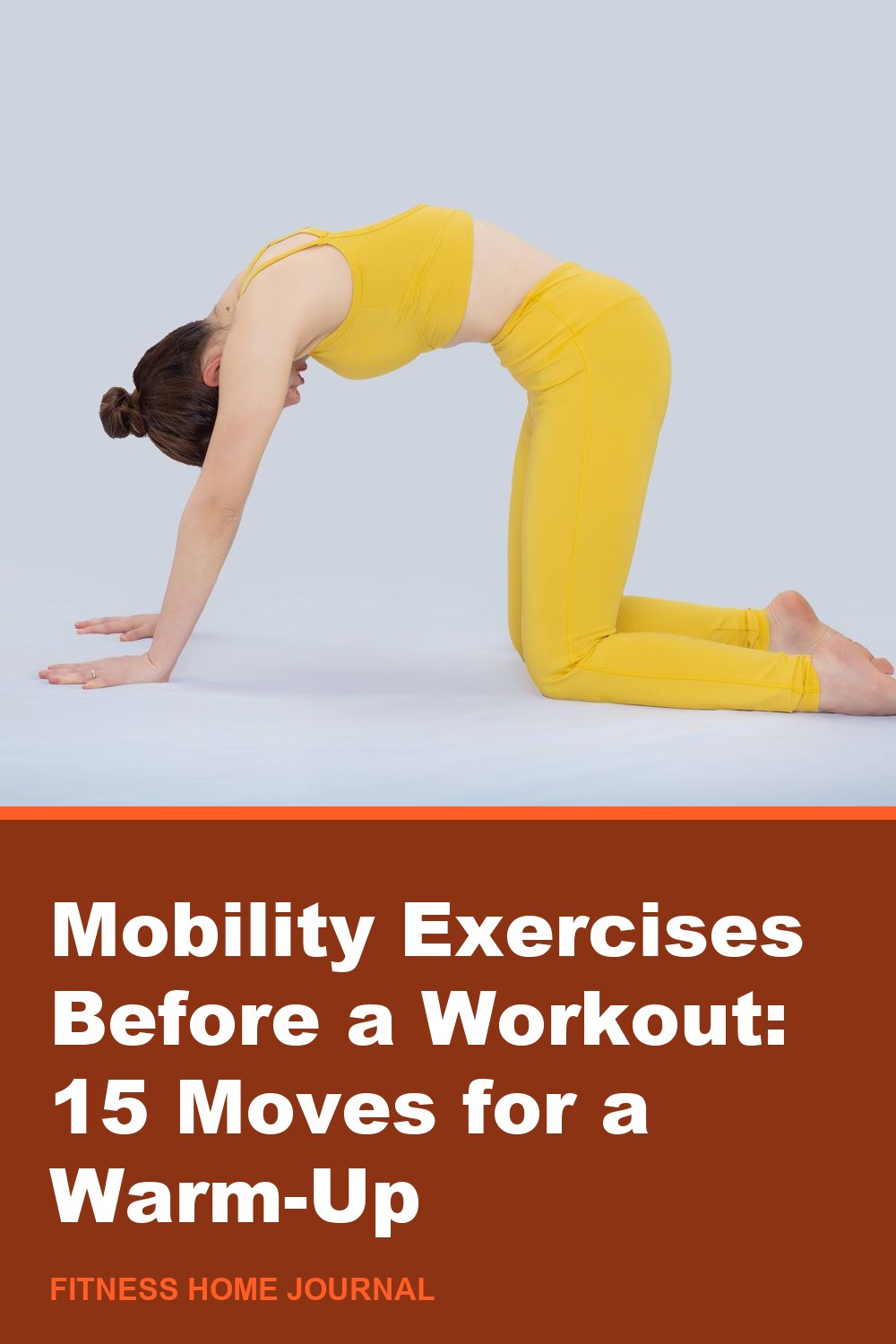

- Spend 10-15 minutes on dynamic mobility moves before training to raise blood flow and prepare your joints for the session.
- Do the 15-move sequence 2-3 times a week at minimum, and reuse it slower after training to support recovery and ease soreness.
- Small, frequent sessions beat rare long ones, so start with 8 moves in week 1 and build to the full list by week 2.
The best mobility work before a workout is 10-15 minutes of dynamic movements that take your joints through their full range, from the neck down to the ankles. Below are 15 moves, with sets, reps and rest, that you can run as a warm-up before lifting, running or yoga, and repeat more slowly as a cool-down. It matters now because more people are training at home, where nobody hands you a warm-up. Mobility has become a routine worth building into your week, not a bonus you skip when time is short.
Why 10-15 minutes of dynamic mobility belongs before you train
Mobility work focuses on the range of motion in your joints and the flexibility of your muscles. According to Fitness Home Journal's earlier coverage, better mobility makes joints work more efficiently, lowers injury risk and supports strength and endurance. It also increases blood flow and can improve your exercise form.
The benefit is not limited to one style. Whether you lift, do yoga or pilates, or train hard at high intensity, the same preparation applies. Choose movements that mimic daily activities, such as squatting, reaching and rotating, and you prepare your body for resistance training and cardio alike.
One honest caveat: no single drill below is proven to prevent a specific injury. Treat lower injury risk as a reasonable expectation from moving better, not a guarantee. If a movement hurts, or you have a joint condition or an old injury, see a doctor or physiotherapist before you carry on.
The 15-move warm-up sequence, head to toe
Work through the list in order, one set each, moving smoothly instead of forcing end range. With about 40-45 seconds per move, the whole sequence takes roughly 11-12 minutes, inside the 10-15 minute window.
| # | Movement | Sets x reps | Rest | Note |
|---|---|---|---|---|
| 1 | Neck rotations | 1 x 5 each side | 0-5 sec | Slow turns, chin level, no cranking. |
| 2 | Arm circles | 1 x 10 each direction | 0-5 sec | Start small, grow the circle. |
| 3 | Thread the needle | 1 x 6 each side | 0-5 sec | On all fours, rotate the upper back. |
| 4 | Cat-cow | 1 x 8 | 0-5 sec | Move the whole spine, breathe steadily. |
| 5 | Band or towel pass-throughs | 1 x 10 | 0-5 sec | Wide grip, arms straight, go only as far as is comfortable. |
| 6 | Wall slides | 1 x 8 | 0-5 sec | Keep forearms and back against the wall. |
| 7 | Wrist circles | 1 x 10 each direction | 0-5 sec | Worth doing before push-ups or presses. |
| 8 | Leg swings, front to back | 1 x 10 each leg | 0-5 sec | Hold a wall, stay tall. |
| 9 | Lunge with reach and rotation | 1 x 4 each side | 0-5 sec | Open the chest toward the front knee. |
| 10 | 90/90 hip switches | 1 x 6 each side | 0-5 sec | Sit tall, switch knees without using hands if you can. |
| 11 | Deep squat hold | 1 x 30 sec | 5-10 sec | Press elbows against knees, heels down. |
| 12 | Glute bridge | 1 x 10 | 0-5 sec | Squeeze at the top, ribs down. |
| 13 | Ankle rocks | 1 x 10 each side | 0-5 sec | Knee travels over toes, heel stays planted. |
| 14 | Walking lunge with twist | 1 x 5 each side | 0-5 sec | Rotate over the front leg. |
| 15 | Inchworm | 1 x 5 | 10 sec | Walk hands out, walk feet in, soft knees allowed. |
Running the sequence at home without a coach
Set it up once so it needs no thought. Lay out a mat and, if you have one, a light band or a towel for move 5. Use a phone timer so you are not counting seconds in your head.
- Do the sequence before every strength, cardio or yoga session, aiming for at least 2-3 mobility sessions a week.
- Keep movements controlled and smooth, which is the point of dynamic work.
- Stay in a comfortable range. A mild stretching sensation is normal, but sharp or pinching pain is a signal to stop and back off.
- Follow with your first lifts at light weight, so the new range goes straight into the pattern you are about to train.
If you want a session to pair it with, the no-equipment home strength routine works well straight after this warm-up. For something printable to keep near your mat, the Honest Toolkit full body workout checklist at this printable page is a handy companion.
Shrink it or stretch it to fit the day you have
You do not need the whole list every time. Match it to your energy and your schedule.
When you are short on time or stiff:
- Halve the reps and keep every range small.
- Use a wall or chair for balance on moves 8, 9 and 14.
- Cut to the 8 moves that suit your session, such as 3, 4, 8, 9, 10, 11, 13 and 15 before a lower-body day.
When you feel good and want more:
- Pause for 2 seconds at the end of each rep, still without forcing it.
- Slow every rep to a count of three each way.
- Run the sequence twice for moves where you feel tightest, though keep the total near the 15-minute mark.
Variety helps too. Try different versions of the movements and keep the ones that match what your body actually needs, since stiffness is rarely identical from person to person.
Four weeks from first session to a full routine
Consistency matters more than volume here. Even small, frequent sessions can add up to significant improvement over time, so build slowly.
- Week 1: Choose 8 moves from the table and do them for 1 set, 2-3 times this week. Learn the order and the ranges.
- Week 2: Add the remaining 7 moves and do the full sequence for 1 set, 3 times this week, about 11-12 minutes each.
- Week 3: Keep the full sequence and add the 2-second pause at end range on every move you can do comfortably.
- Week 4: Do the full warm-up before training, and add a shorter, slower version of 5-6 favorite moves after a session as a cool-down.
After week 4, keep the pattern and rotate in the variations. Judge progress by how your squat, overhead reach and lunge feel, rather than by chasing extreme range.
Using the same moves to cool down and recover
Mobility drills after training can ease muscle soreness and help recovery. Choose 5-6 moves from the list, slow them down and keep the effort low, aiming for 5 minutes or so. If you are coming back from a long race, our marathon recovery plan shows how to ease back safely. For longer-term joint health, staying fit after 40 covers strength, mobility and food together.
As an Amazon Associate I earn from qualifying purchases: if you buy through these links I may earn a small commission, at no extra cost to you. Each link opens a search on the Amazon store for your country.
Photo: Vi Nguyen / Pexels

I'm an Italian creator who builds apps, games and websites. I run Fitness Home Journal with the help of AI tools: every article starts from the sources linked above, and I check what goes out. I'm not a doctor, a lawyer or a financial adviser. Spotted a mistake or have an idea? Write to me.
Instagram @spartaco_94_My websiteWrite to meAbout this blog










 Reinventing Yourself After 40: A Guide to Embracing Change and New Beginnings





