 Fitness Home Journal

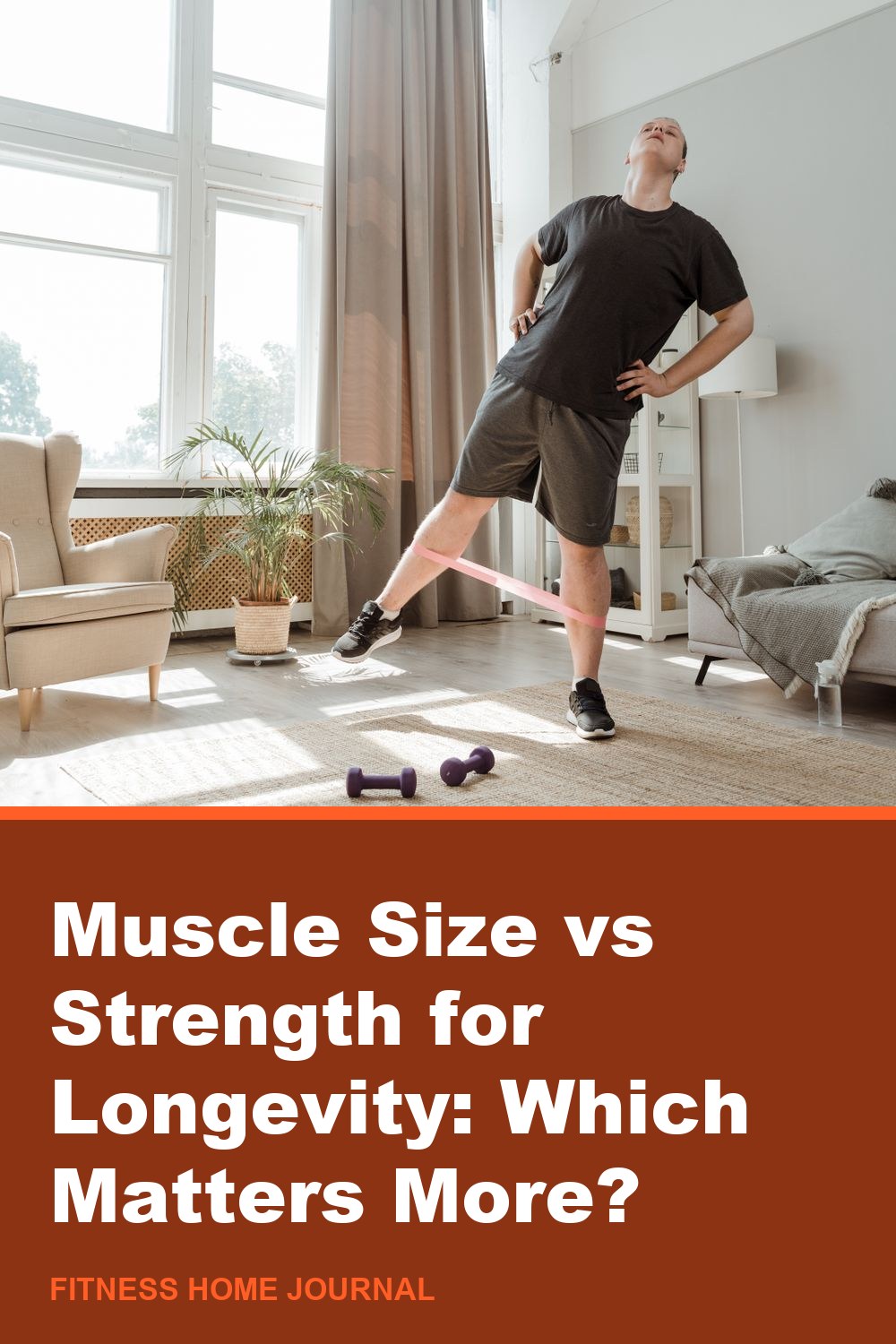

- Muscle size and strength both track with longer life, but strength is what you use to stand up, climb stairs and carry things as you age.
- For strength, do 2 to 3 sets of 4 to 8 reps with a load that feels heavy; for size, 8 to 12 reps works, or 20 to 25 with lighter weights.
- Stop most sets with about two good reps left (RPE 8), and train the whole body; targeting one muscle, such as the calves, is not the point.
If you have to pick one, pick strength, but you rarely have to. Muscle size and muscle strength both fall with age, both are linked to better health, and the same home routine can build both when you set the reps and effort correctly. The question is back in the news because a 2026 study in JAMA Network Open tied higher muscle strength to lower mortality in older women, which sharpens the old debate over whether you should train to look muscular or to get strong.
The belief: bigger muscles mean a longer life
It is an easy idea to believe. According to Fit&Well, scientists are fairly confident that overall muscle mass is one of the best predictors of how long we live. A 2022 systematic review found that for every 1 cm of extra calf circumference, the risk of death fell by an average of 5%.
That sounds like an instruction to grow your calves. It is not. Physical therapist Kara McKeown told Fit&Well the research does not show that chunky calves help you live longer. Calf size works as a reliable marker of overall strength and muscle mass. The researchers also noted that calf circumference beats thigh and upper-arm measurements as a muscle marker because the calf holds more lean mass.
The same article makes a second point. Calves do act as an assisting pump. Podiatrist Dr Mikel Daniels explains that each contraction squeezes the veins in the muscle and helps push blood back toward the heart against gravity. You get that effect simply by walking, he says, and targeted calf training will not directly lower blood pressure or prevent cardiovascular events. The link between poor calf pump function and higher mortality is correlation, not proof of cause.
What the evidence says: size and strength are not the same thing
Women's Health spoke to several experts who draw a clear line between the two. Orthopedic surgeon Vonda Wright, MD, describes hypertrophy training as aiming to enlarge the muscle, while maximal strength training aims to raise the force the muscle can produce, often measured by how much you can lift in an exercise. Bigger muscles have the potential to produce more force, but size alone does not decide strength. As Wright puts it, a smaller person can sometimes be stronger than someone with visibly larger muscles.
Why? Muscle researcher Stuart Phillips, PhD, of McMaster University, says strength depends on more than size. It also depends on how well your nervous system activates the muscle and how efficiently you perform the movement. That is why heavy practice matters for strength in a way it does not for size.
Why strength gets the edge for daily life comes down to what you actually do with it. Exercise physiologist Mark Kovacs, PhD, says muscle supports joints and bones and helps regulate metabolism, while strength lets you put that muscle to work: carrying groceries, climbing stairs, getting up from the floor. He gives a simple example. Rising from a chair takes a small share of your maximum strength when you are young. As your strength drops, the same movement takes a bigger share of what you have left. Keep building strength and you keep a reserve.
The JAMA Network Open study fits this picture. More than 5,000 women aged 63 to 99 were tested on grip strength, chair stand performance and a timed walk. Higher muscle strength was associated with lower mortality.
Who this applies to, and what it does not prove
Be honest about the limits. The study above looked at women in their sixties to nineties, and it found an association. It does not show that raising your strength will, by itself, add years. The calf research is also correlation. Fit&Well's experts point out that movement, circulation and activity levels all promote longevity, and strong, well-used muscles go along with all three.
So treat the evidence as a strong reason to train, not a guarantee. It applies to nearly every adult who wants to stay mobile and independent, and the habit pays off earlier than you might expect, because muscle and strength both decline naturally with age. If you have an injury, a heart or joint condition, or you are new to lifting after a long break, check with your doctor before loading up.
Do this instead: one home routine that builds both
You do not need to choose a camp. You need to know which dial you are turning on each set.
For strength: heavy for you, few reps
Phillips recommends 2 to 3 sets of roughly 4 to 8 reps with a challenging weight, stopping before your technique breaks down. At home, heavy is relative. Dumbbells work well for goblet squats, Romanian deadlifts and one-arm rows. With bodyweight or bands, make the move harder rather than longer: slow the lowering phase, elevate your feet for push-ups, or shift to single-leg versions of squats and hinges. If you can easily do 15 reps, the exercise is no longer a strength exercise for you. Phillips notes that lighter weights can still make you stronger, but taking them to failure does not automatically make them equal to heavier work for maximal strength.
For size: more reps are fine if the effort is real
For muscle growth, both light and heavy loads work as long as the set is challenging enough. Phillips's own research found that about 20 to 25 reps with light weights produced similar growth to sets of 8 to 12 with heavier weights when both went to failure. That is good news for band and light-dumbbell trainers. A single hard set per exercise, done consistently, can grow muscle, though multiple sets generally do better.
The effort check: leave about two reps in the tank
Phillips suggests choosing a weight that makes the last few reps hard while leaving about two good reps in reserve. On the 1 to 10 rating of perceived exertion scale, an 8 means about two reps left, a 9 means one, and a 10 means failure. If you finish 25 reps and feel you could easily do five more, the weight is probably too light to stimulate growth.
A simple week for busy adults
Here is one way to put this into practice. The structure is my coaching suggestion, built on the rep and effort guidance above.
- Two to three full-body sessions a week. McKeown's advice is full-body training rather than singling out one muscle group.
- Start each session with a strength block. Pick one squat or hinge and one push or pull. Do 3 sets of 4 to 8 reps at about RPE 8, with good form on every rep.
- Finish with a size block. Pick two or three more moves, such as band rows, push-ups, split squats or calf raises. Do 2 to 3 sets of 8 to 12 reps with a heavier load, or 20 to 25 with a lighter one, again leaving about two reps in reserve.
- Short on time? Do one hard set of each move. It counts, even if more sets usually work better.
- Walk on the other days. It gives you the calf-pump benefit Daniels describes without extra effort.
Progress by adding a rep, a slower lowering phase, a heavier dumbbell or a stronger band once your top set feels easier than RPE 8. Do not chase failure on every set. For workout ideas, our no-equipment home strength routine covers the bodyweight side, and our 16-minute dumbbell leg workout shows how little gear you need. If you want a printable plan to stick on the fridge, the Honest Toolkit has a full-body workout checklist.
Track strength, not just the mirror
The older-women study measured grip, chair stands and a timed walk, so those are sensible things to watch in your own life too. Without a lab, you can still keep a log of the things Kovacs mentions: how easily you rise from a chair or the floor, how heavy a bag you can carry up stairs, and the load and reps on your top set each week. If those numbers climb, you are building the reserve that makes daily life easier at 50, 70 and beyond.
Size will usually follow along, and you will gain some of it simply by training. For more on the growth side, see our muscle-building fundamentals.
The short version for your next workout
Muscle size is a useful marker of health, but strength is what you rely on when you stand up, climb and carry. Train both in the same session: a few heavy reps first, then moderate or high reps to build size, all with a couple of reps held back. Keep walking, keep the routine full-body, and see a doctor if pain or a medical condition gets in the way.
As an Amazon Associate I earn from qualifying purchases: if you buy through these links I may earn a small commission, at no extra cost to you. Each link opens a search on the Amazon store for your country.
Watch or listen to this episode
Sources
- Women's Health – Fitness: Muscle Size vs. Strength: Which Matters More for Living Longer? Experts Explain
- Fit&Well: Why doctors call your calves your second heart—and what their size says about your longevity
Photo: MART PRODUCTION / Pexels

I'm an Italian creator who builds apps, games and websites. I run Fitness Home Journal with the help of AI tools: every article starts from the sources linked above, and I check what goes out. I'm not a doctor, a lawyer or a financial adviser. Spotted a mistake or have an idea? Write to me.
Instagram @spartaco_94_My websiteWrite to meAbout this blogWritten by Ciro Irmici (Ciro Simone Irmici), with the help of AI tools. Ciro Irmici's website











 Reinventing Yourself After 40: A Guide to Embracing Change and New Beginnings





